JNARDDC Nagpur Recruitment 2026: Five Research and Project-Support Positions, Walk-in on 2 December
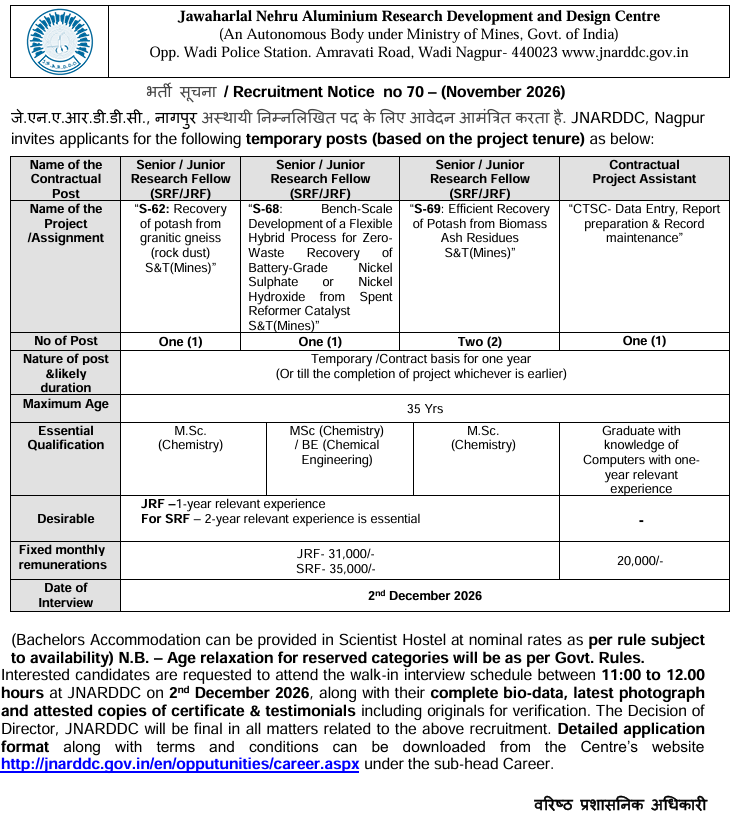
The Jawaharlal Nehru Aluminium Research Development and Design Centre (JNARDDC), Nagpur, an autonomous institution under the Government of India's Ministry of Mines, issued Recruitment Notice 70 (November 2026) on 28 November 2026. The notice concerns five temporary project-linked positions: four openings arranged across three mineral-recovery research assignments under the common Senior Research Fellow / Junior Research Fellow (SRF/JRF) designation, plus one Contractual Project Assistant assignment in CTSC data entry, report preparation and record maintenance. Candidates have been asked to attend a walk-in interview on 2 December 2026 between 11:00 AM and 12:00 noon at JNARDDC, opposite Wadi Police Station, Amravati Road, Wadi, Nagpur 440023.
A central distinction governs this advertisement: five positions do not mean five different research fellowships. The first three project allocations comprise one position in S-62, one in S-68 and two in S-69, collectively four research positions. The remaining seat is a separate project-assistant role. Each SRF/JRF opening represents one position at an eligible fellowship level, not one JRF seat plus another SRF seat. The notice does not specify how many of the four selected research appointments will ultimately be designated JRF versus SRF. The salary depends on that designation, which is why neither a four-JRF/four-SRF assumption nor a combined eight-seat count would be correct.
At a glance: what is actually advertised?
These are fixed monthly remuneration amounts published for temporary appointments, not the pay scales of regular central-government positions. The advertisement does not promise government pay-matrix levels, annual increments, HRA, a permanent job, an automatic promotion from JRF to SRF, or a pension. It does mention possible bachelors' hostel accommodation at nominal rates, strictly subject to availability and applicable rules; this is neither a guaranteed facility nor free housing.
Project-wise vacancies: four research appointments, one support post
🥧 JNARDDC 70/2026 official vacancy allocation
S-69 accounts for two of the five announced posts, or 40% of the total; each of the other three lines accounts for 20%. The four research places collectively make up 80% of the recruitment. Those percentages are straightforward arithmetic from the official post counts, not a reservation breakup, because no category-wise roster is printed in this short notice. There is no justification for inventing UR/OBC/SC/ST/EWS allocations against these project seats.
The three research projects are technically different
S-62 — Potash recovery from granitic gneiss rock dust
The project is explicitly concerned with recovering potash from granitic gneiss (rock dust). Granitic gneiss is a hard-rock material; the phrase “rock dust” identifies the feedstock as a finely divided mineral-derived material rather than an agricultural ash or a conventional soluble potash product. The scientifically relevant question is how potassium-containing mineral material can be characterised and processed for recovery. For an applicant with an M.Sc. in Chemistry, experience in inorganic or analytical chemistry may help explain a prior research profile during interview, but the recruitment notice does not mandate any named instrument, extraction reagent, analytical test, potassium yield, flowsheet or prior work with granitic gneiss. Those would be speculative criteria unless JNARDDC separately publishes them.
This assignment should appeal to chemists interested in the interface between mineral material, laboratory measurements and resource recovery. Applicants should be ready to describe the chemical and analytical work they have actually performed; they should not present imagined project targets as conditions imposed by the recruiter. The post is one SRF/JRF opening, and the essential academic degree is M.Sc. Chemistry.
S-68 — Bench-scale battery-grade nickel sulphate or nickel hydroxide
The second research assignment is titled “Bench-Scale Development of a Flexible Hybrid Process for Zero-Waste Recovery of Battery-Grade Nickel Sulphate or Nickel Hydroxide from Spent Reformer Catalyst.” Several words in this title matter to understanding the job. “Bench-scale” describes a development stage rather than a claim of commercial-scale operation. “Spent reformer catalyst” is the advertised waste-derived input. “Nickel sulphate or nickel hydroxide” identifies alternative targeted chemical products; it is not evidence that two separate posts are being offered or that both products must necessarily be manufactured. “Zero-waste” is part of the project's research aim, not proof that a particular process has already achieved zero residue.
This line alone opens two alternative academic routes: M.Sc. Chemistry or B.E. Chemical Engineering. A Chemical Engineering graduate therefore qualifies for this project route on the basis specified in the notice without being required to hold an M.Sc. in Chemistry as well. Conversely, Chemical Engineering is not included as an alternative in the S-62 or S-69 rows. The difference is material when choosing the correct project allocation and preparing educational certificates.
JNARDDC's publicly described broader work includes mineral and metal processing, recovery from industrial residues and critical-mineral recycling. That provides context for why a spent-catalyst nickel project belongs at this centre. It is contextual institutional information, not an extra eligibility condition, a promise of assignment to a particular division, or evidence of a specified experimental technique for this vacancy.
S-69 — Potash recovery from biomass ash residues
The third project is “Efficient Recovery of Potash from Biomass Ash Residues”, and it has two research-fellow positions, the largest single project allocation. Unlike S-62, whose source material is granitic rock dust, S-69 concerns an ash residue produced from biomass. Both titles refer to potash recovery, but the inputs and associated research considerations are different. A candidate should not collapse these vacancies into a generic “potash research” line: one post belongs to a mineral-rock feedstock project; two belong to biomass-ash residues.
The essential degree printed for S-69 is M.Sc. Chemistry. JNARDDC has not supplied an advertised laboratory technique list, proof of experience in biomass power plants, mandatory publication record, or GATE/NET qualification for this specific notice. The candidate's actual Chemistry degree and relevant experience profile should therefore be assessed against the stated notice, without introducing additional filters that the recruiting authority did not prescribe.
JRF versus SRF: the experience rule is asymmetrical
For the three research projects, the notice gives the essential educational qualifications in project-specific columns and separately states the experience criterion: one year of relevant experience for JRF is desirable, while two years of relevant experience for SRF is essential. The words desirable and essential are not interchangeable. A qualifying degree holder lacking the desirable JRF experience is not automatically excluded by that line alone; a candidate seeking appointment as SRF must satisfy the specifically required two years of relevant experience. The notice does not define a universal compulsory one-year experience threshold for every research-fellow applicant.
The relevant-experience period is stated in years but the advertisement does not define a separate experience cut-off date or a formal scoring formula for converting research work into marks. Applicants should therefore rely on documentary evidence rather than unsupported assumptions about what counts: actual role titles, date ranges, employer or laboratory, and verifiable technical work can help an interviewing panel understand the claimed experience. These are practical preparation suggestions, not additional application conditions.
Contractual Project Assistant: not an interchangeable fellowship
The CTSC Data Entry, Report Preparation & Record Maintenance assignment is an administrative/technical-support function within the advertised project arrangement. The essential educational description is “Graduate with knowledge of Computers with one-year relevant experience.” This means graduation alone is not the entire requirement: computer knowledge and one year of relevant experience are explicitly part of the row. At the same time, the advertisement does not name a required computer certificate, a particular degree discipline, a typing-speed threshold, an MS Office certification, or a specific test. Those must not be inserted as hard eligibility barriers.
The work label identifies three practical activity types: maintaining data entries, preparing reports and keeping records. In institutional projects, accurate versioning and traceable supporting documents are important, but the notice does not prescribe a software package, database platform, key-performance target, or exact shift. Applicants who have handled records, tabulation, report formatting or digital document workflows can describe their relevant experience at interview; they must not assume a written or computer skill examination has been announced, because it has not.
Fixed monthly remuneration: compare the rates correctly
📊 JNARDDC 70/2026 official monthly remuneration by designation
The ₹4,000 monthly gap between SRF and JRF is an announced designation difference, not a universal increment available after one year. SRF's ₹35,000 is ₹15,000 more than the Project Assistant's ₹20,000; the JRF figure is ₹11,000 more than the Project Assistant's. These comparisons are derived from the fixed amounts in the original notice and should not be mistaken for total take-home pay or a promise of allowances. Because the notice does not allocate the four research positions between JRF and SRF, the total monthly payout for the full five-post cohort cannot be presented as one guaranteed official budget. The correct statement is that the announced fixed rate for each selected individual depends on the designation.
The initial tenure is one year or until completion of the project, whichever is earlier. Thus, the phrase “one year” is not a guaranteed minimum tenure. It does not establish an entitlement to a renewal. The institution also notes that bachelors' accommodation can be provided in the Scientists' Hostel at nominal rates according to rules, subject to availability. Neither hostel allotment nor an accommodation allowance is guaranteed in the advertisement.
Maximum age and relaxation
The notice prints a maximum age of 35 years for the advertised posts. It does not specify a separate minimum age or explicitly state the exact date at which 35 years is to be calculated. The age field must therefore preserve the published maximum without inventing a 1 December or 2 December birth-date cut-off. It also says age relaxation for reserved categories will apply under Government rules, but gives no numerical relaxation table, category-wise extension or caste roster. Applicants should refer to applicable rules and follow JNARDDC's decision on individual eligibility rather than applying an arbitrary age adjustment from another examination.
Walk-in interview: date, hours, place and documents
The advertised selection method is a walk-in interview, scheduled for Wednesday, 2 December 2026, between 11:00 AM and 12:00 noon, at JNARDDC, Opposite Wadi Police Station, Amravati Road, Wadi, Nagpur – 440023. This is the interview window stated by the recruiting centre; the notice does not publish a separate registration-closing hour, a list of interview slots, a written-test date or a merit weighting. Do not confuse this with an online application deadline. For this 70/2026 notice, the published call is to attend in person with the prescribed material.
Candidates are asked to bring their complete biodata, latest photograph, attested copies of certificates and testimonials, and originals for verification. A candidate targeting the research-fellow designation should make the Chemistry or Chemical Engineering qualification easy to confirm and have clear documents for the relevant research experience claimed, particularly if seeking SRF designation. The project assistant should bring a degree certificate and evidence of the stated one-year relevant experience. The notice does not prescribe the number of photocopy sets, a particular attestation authority, a fee receipt or a caste-certificate form; adding such specifics as mandatory would be misleading.
Useful document-check sequence
- Carry your academic degree certificates and supporting mark sheets corresponding to the eligible route for the selected project.
- Keep documents showing relevant experience periods and the nature of work, particularly for the essential two-year SRF condition or the Project Assistant's one-year condition.
- Take the completed biodata, latest photograph, attested copies of certificates/testimonials, and originals for verification, as specifically requested.
- Identify the correct S-62, S-68, S-69 or CTSC assignment in your preparation rather than assuming every candidate is eligible for every row.
- Check the recruitment notice and the centre's official recruitment webpage again before travelling in case JNARDDC publishes an update.
These points organise the requirements actually printed in the notice. They do not create a separate prescribed list of enclosures or an application deadline that is absent from the advertisement. The JNARDDC careers page also provides a downloadable blank application format; however, the walk-in notice itself specifically names complete biodata, photograph, attested copies and originals. Applicants should use the current form offered through the official recruitment page where applicable, without relying on a form from an unrelated older recruitment.
How the selection process is described—and what it does not say
The 28 November advertisement announces a walk-in interview and states that the decision of the Director, JNARDDC will be final in all matters related to this recruitment. There is no advertised written examination, skill-test syllabus, interview-mark distribution, application fee, list of category-wise vacancies, shortlist count, question-paper pattern or separate joining date in this notice. The absence of a fee amount does not itself prove that the authority has formally waived all fees; it simply means a numeric application fee has not been notified in the source reviewed here.
The source also does not describe a GATE, CSIR-UGC NET or JRF entrance-score condition. One should not borrow eligibility from other institutions' fellowships or from another JNARDDC advertisement. In this recruitment, eligibility is the notice-specific academic and relevant-experience requirement, and the actual interview is the published selection event.
Which post is suitable for which background?
The distinction between the degree, experience level and project assignment is the most useful way to interpret this recruitment. A master's degree alone does not automatically make a candidate an SRF. Chemical Engineering is an allowed alternative for the spent-catalyst nickel project only. And Project Assistant is a separate support designation rather than a lower-paid JRF post.
Institutional research context, without adding unstated eligibility
JNARDDC's official programme information places the institution in mineral processing, metal recovery, recycling and utilisation of residues. Its public S&T-PRISM activity describes work spanning mineral beneficiation, refining and purification, product development and industrial waste utilisation; examples include nickel recovery and other critical-mineral projects. This wider context helps distinguish the advertisements' mineral-resource projects from ordinary academic fellowships. It should not be read as confirmation that the selected fellows must work on a particular third-party project, operate a named apparatus or meet extra qualifications beyond Notice 70/2026.
The three research titles point to separate source materials: a rock-derived potassium-bearing feedstock in S-62, an industrial spent catalyst and nickel-product pathway in S-68, and biomass-derived ash in S-69. Such separation matters for a candidate selecting where to present genuine strengths in Chemistry or Chemical Engineering. The advertisement itself, rather than any invented job description, remains the authority for the employment conditions.
Final applicant checklist and primary source
The practical decision is time-sensitive: the original advertisement is dated 28 November 2026, and the walk-in is only four calendar days later, on 2 December. There is no separate online application receipt date printed for this notice. Confirm which of the four allocation rows fits the degree, distinguish essential experience from desirable experience, prepare biodata and certificates, and report at the Nagpur centre within the notified window. The contract is temporary, and no assured extension or regularisation is offered in the advertisement.
Original Recruitment Notice 70/2026: https://www.jnarddc.gov.in/Files/CareerNew/7lKR639314596044843955.png
Official JNARDDC contractual/temporary vacancies page: https://www.jnarddc.gov.in/hindi/opputunities/contractual_temporary.aspx
JNARDDC official institutional website: https://www.jnarddc.gov.in/